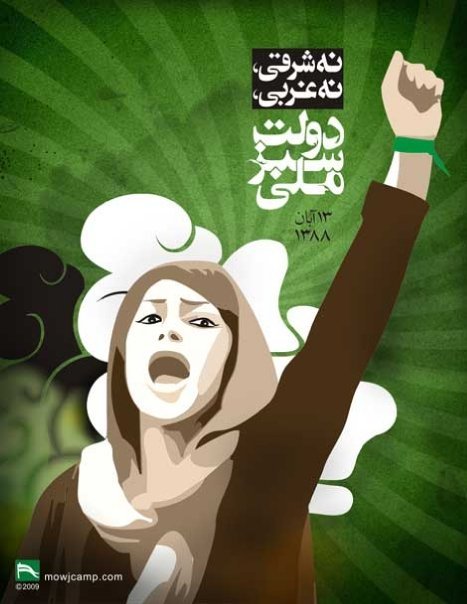
Showing posts with label Iran Election. Show all posts

Tuesday, February 2, 2010

White moderates and greens


http://www.payvand.com/news/10/jan/1297.html

American pundits who pontificate on the internal affairs of others only reveal themselves as irrelevant and ridiculous, writes Hamid Dabashi

I must confess that over the past few years I have been gravely disappointed with the white moderate. I have almost reached the regrettable conclusion that the Negro's great stumbling block in his stride toward freedom is not the White Citizen's Councillor or the Ku Klux Klanner, but the white moderate, who is more devoted to "order" than to justice; who prefers a negative peace which is the absence of tension to a positive peace which is the presence of justice -- Martin Luther King, Jr, "Letter from a Birmingham Jail," 16 April 1963

The only reason the world at large should take notice of what American pundits think of the Green Movement in Iran is that their self-indulgent pontificating reveals much about the troubled world we live in and that they think they must lead. Indeed, one of the most magnificent aspects of the unfolding civil rights movement in Iran is that it acts as a catalyst to expose the bizarre banality of American foreign policy commentary and its limitations in dealing with the rest of the world. Those in American circles that are of the "bomb Iran" persuasion are lost causes just like the Ku Klux Klan. It is the equivalent of what in a different context Martin Luther King Jr called "the white moderates" that warrants more attention.

Perhaps the single most important problem with American politics, policymakers and pundits -- left or right, liberal or conservative, Democrat or Republican -- is that they think that anything that happens anywhere in the world is about them or is their business. The imperial hubris that seems definitive of the DNA of this political culture wants either to invade and occupy other people's homelands and tell them what to do, or else disregard people's preoccupation with their own issues and impose, demand and exact "engagement" with them, whether they want it or not.

Take the most recent piece of nonsense published on the civil rights movement in Iran by Flynt and Hillary Leverett, "Another Iranian Revolution? Not Likely" ( The New York Times, 5 January 2010), which has absolutely nothing to do with or seriously to say about the Green Movement, and yet everything to reveal about the pathology of American politics as determined inside the self-delusional Beltway cocoon.

As early as mid-June 2009, the Leveretts defending the fraudulent election of Mahmoud Ahmadinejad ("Ahmadinejad won. Get over it," Politico, 15 June 2009). That millions of Iranians had poured into their streets and put their lives on the line did not seem to bother the Leveretts. In addition to a condescending tone, in which the Leveretts partake freely when talking about a groundbreaking civil rights movement about whose origin and disposition they are categorically ignorant, the chief characteristic of their take is that they keep fabricating non-existent targets and then shooting them down. The result: what say has everything to do with the besieged and bunkered mentality inside the Beltway and absolutely nothing to do with the Green Movement. Chief example: "The Islamic Republic of Iran," they believe, "is not about to implode. Nevertheless, the misguided idea that it may do so is becoming enshrined as conventional wisdom in Washington."

Whoever said it was? No scholar or otherwise serious and informed observer of Iran writing in Persian or any other language and still in her or his right mind can predict -- or has predicted -- that the Islamic Republic will or will not fall, and even if it did, one way or another, it would have nothing to do with what "conventional wisdom in Washington" opts to enshrine or not to enshrine. If there are folks inside the Beltway who think the Islamic Republic will fall any day now, Abbas Milani will become the American ambassador to Iran, or the Iranian ambassador to the US, depending on the season of his migrations to the left or right, and Lolita will soon become required reading in Iranian high schools, well that's their problem, and yet another sign of their dangerously delusional politics. That hallucination has nothing to do with the Green Movement, and thus the Leveretts need not have sought (in vain) to discredit a monumental social uprising of whose origin and destination they are oblivious.

These Washingtonians live in a world of their own. A massive civil rights movement has commenced in a rich and diversified political culture of which people trapped inside the Beltway have no clue. Thus what American pundits make of it is entirely irrelevant. This is a civil rights movement some two hundred years in the making, whose course and contours will be determined inside Iran and by Iranians. No Iranian could care less what people in halls of power in the United States think of their uprising, unless and until they start harming it. There are two sorts of harm: economic sanctions, covert operations and military strikes, advocated by the likes of Milani; or else engaging with the illegitimate and fraudulent government of Mahmoud Ahmadinejad, as the Leveretts advocate. These are both interferences in the domestic affairs of Iran. Mr and Mrs Leverett ought to know they will be remembered in Iranian history as the 21st century equivalent of Kermit Roosevelt if they persist, as they have since the commencement of the Green Movement in June 2009, in actively siding with what in Iran is called "the coup government of Ahmadinejad".

The supreme irony of the Leveretts' position is that while the ghastly propaganda machinery of the Islamic Republic accuses anyone who utters a word against their criminal atrocities of being "an agent of CIA", here is an ex- CIA agent acting as the greatest proponent of their theocratic terrorism. The Leveretts' main concern is with President Obama hurrying up to "engage" Ahmadinejad before it is too late. To pre-empt neocon belligerent chicanery the Leveretts seek to push the president in the direction of diplomacy with Ahmadinejad's administration. That legitimate and even laudable and noble concern, however, soon degenerates into an arrogant and ignorant dismissal of an entire civil rights movement as something ephemeral and even non- existent.

The best thing that President Obama has done so far, in fact, is not to engage with the fraudulent and criminal government of Ahmadinejad, listening carefully to the masses of millions of Iranians chanting "Obama, Obama, you are either with them or with us!" And "them" is the brutal theocracy whose security apparatus kidnaps, tortures, rapes and murders its own citizens, when it is not busy putting their political and intellectual leaders on show trials in Kangaroo courts -- facts inconsequential to the Leveretts' realpolitik and yet concerning men -- like Mehdi Karrubi, Mir Hussein Mousavi and Mohamed Khatami -- who have been at the heart of the Islamic revolution, leading it for the last 30 years and who are still deeply committed to the Islamic Republic. It would be utterly catastrophic (both for Iranians and for long term US-Iran relations) if President Obama were to listen to and do as the Leveretts tell him to do.

The entire argument of the Leveretts dwells on a silly number game, like belligerent teenagers comparing the size of their vanities, all set in a prep school adolescent debating club mentality, questioning the numbers of antigovernment and pro-government rallies. Comparing and contrasting the two massive demonstrations in the holy months of Muharram, one against the government and the other orchestrated by it, the Leveretts sound entirely identical with the propaganda machinery of the Islamic Republic that dismisses one as insignificant and peripheral and celebrates the other as "possibly the largest crowd in the streets of Tehran since Ayatollah Ruhollah Khomeini's funeral in 1989." In this bogus assessment the Leveretts ignore the fact that in one of these demonstrations people were beaten up, shot at, run over by armoured trucks, or else arrested and taken to the dungeons of the Islamic Republic to be tortured, raped and murdered, while in the other they are provided with complementary food and beverages, paraded on national television, and given the day off from work and school.

This is not to suggest that all who went to the staged rally did so just because their livelihood and monthly paycheques were at stake, for their religious sensibilities were equally manipulated by a sinister and abusive regime. But this entire number game is a silly and useless diversion, and of interest only to discredited expatriate oppositional groups or else to the propaganda machinery of the Islamic Republic, which the Leveretts now echo. Neither do all those who participated in the Ashura demonstrations wish to topple the Islamic Republic, nor are all those who were manipulated to join the counter-demonstrations supporters of Ahmadinejad. This fixation with numbers is played on the false field of a supposition that the Islamic Republic is about to fall, whereas for the last seven months anyone who knows anything about Iran has insisted that this is not a revolution but a civil rights movement; a marathon, not a 100-metre sprint.

Another equally useless and diversionary goose chase that the Leveretts play -- a game that shows they are completely out of touch -- is when they start talking about the seventh day memorial of one death or another. What happened in the seventh day commemoration of Grand Ayatollah Montazeri's death on 27 December 2009, which coincided with the Ashura on 10th of the holy month of Muharram 1431, is integral to a succession of mass rallies that began on 12 June and has taken any occasion to pour into streets, demand and exact their rightful public space, and show their discontent. Come next anniversary of the Islamic Revolution in February, or the next Chahar Shanbeh Suri, Noruz, or Sizdah Bedar in March, people will do exactly the same. The Islamic Republic may or may not last, under pressure from its own internal contradictions that it may or may not be able to rectify. But that possibility, or even eventuality, is irrelevant to the civil liberties that this movement is demanding and will exact from this or any other regime.


The Leveretts are led to believe that their trump cards are three earth- shattering questions: "Those who talk so confidently about an 'opposition' in Iran as the vanguard for a new revolution," they say, putting the word "opposition" in quotation marks as a way of belittling, ridiculing and dismissing it, "should be made to answer three tough questions: First, what does this opposition want? Second, who leads it? Third, through what process will this opposition displace the government in Tehran?" Well, for one thing the whole world knows by now that the triumvirate of Mousavi, Karrubi and Khatami collectively constitute the core of what literate observers have called, in Persian, rahbari-ye ghaltan, a "rotating leadership". This "leadership" is not, as the Leveretts assume, of the revolutionary model of Khomeini in 1979. These "white moderates"

As for what the movement wants, Mousavi has specified five very clear objectives -- subsequently expanded to 10, ranging from the resignation of Ahmadinejad to freeing all political prisoners and unconditional freedom of the press -- in a historic document that every Iranian around the globe is now discussing but has evidently been kept hidden from the Leveretts. As to how this is to happen, again Mohsen Kadivar, a leading clerical opponent of the Islamic Republic who despite his young age is in fact superior in his juridical rank and learning to the "leader" of the Islamic Republic, has just told Le Monde specifically, in three itemised moves, how they are going to achieve their ends. In this interview, Kadivar recommends a referendum with three options: an Islamic Republic without velayat-e faqih (rule of the clergy); a republic minus the adjective Islamic; or the Islamic Republic with velayat-e faqih. As in any other civil rights movement, Kadivar of course does not speak for the whole movement. But in terms of the sorts of objectives that are now on the table, his language is in the main ballpark.

There is a reason that a gargantuan security and intelligence apparatus, magnified by billions of more dollars after 9/11, is still so incompetent, as just angrily admitted by President Obama, that it cannot even prevent a deranged mind like Umar Farouk Abdel-Mutallab boarding a plane headed to the United States when the man's own father had approached US and Nigerian authorities telling them that his son was about to commit a terrorist act. The Leveretts' myopia is not exclusive to them: it is endemic to the American intelligence community and political punditry. Their failure in understanding the civil rights movement in Iran is predicated on the fact that at best their thinking is mechanical (not organic) and synchronic (not diachronic).

Consider, for example, the Leveretts' most obvious blind spot. They are very particular to inform people that there is no popular revolution in the offing that may topple the Islamic Republic, and yet fail to notice that the Islamic Republic is in fact far more in danger of a naked military coup by the Revolutionary Guard, following what millions of Iranians -- including the very founders of the Islamic Republic -- believe to have been an electoral coup. What about that possibility? Should the Obama administration also deal with a military junta (as it does in Pakistan) while a massive civil rights movement is unfolding? How is this realpolitik different from becoming a mouthpiece for a fanatical theocratic absolutism? Are Iranians thought not to deserve or to know any better?

What is happening in Iran is a "revolution," though not in a mundane politics of despair but in form, in language, in style, in decorum, in demeanour, in visual and performative sublimity. This is a movement that began with song and dance, with poetry and drama, with colour and choreography, with joy, laughter, and hope; with an open-ended hermeneutics of what is possible beyond the written text, or the spoken word, or the mandated morality, or legislated signs. This civil rights movement will change the very alphabet of the region, from form to content, from rhetoric to logic, from Iran across the Arab and Muslim world, and beyond. Student activists from Ohio to Beijing are learning from their Iranian counterparts. In inner city schools around New York there is a new idiom, "going Iranian", meaning not remaining passive in the face of nonsense. This movement is iconoclastic, puts veils on men's head, places women in the front row of rallies, showers cool water and love over security forces that come to beat up their own brothers and sisters.

But all of that is beyond the bunkered banality that passes for punditry in the United States. To speak the inner language of the Beltway, there is not an iota of difference between Bush's waging war on Afghanistan and Iraq and the Leveretts' recommendation for an imperial decree for "engagement" with the Islamic Republic, no matter what diabolic regime flaunts that dubious epithet. But the good news is that Iranians could not care less. If the Leveretts want to fight against their country's immoral, illegal and fattening warmongering they have their work cut out for them inside their own country. They have no business imposing their imperial prescription on a people busy doing some housecleaning of their own. Whether this Green Movement attains its objective a year from now or 10, whether the Islamic Republic will accommodate those civil liberties and survive or fails to do so and joins other political dinosaurs, is none of Leveretts' business, or the American government's for that matter. A people, once again, have arisen to demand and exact their civil liberties. So please, if you don't mind, step aside.

cannot think of a country like Iran having a civil rights movement; in their estimation Orientals are only capable of revolution or military coup.

About the writer: The writer is the Hagop Kevorkian Professor of Iranian Studies and Comparative Literature at Columbia University in New York.

... Payvand News - 01/30/10 ... --


Tuesday, January 19, 2010

Anniversary of Revolution, next rally call for Iran opposition forces


Iranian opposition forces flooded the web with calls for election protesters to join massive demonstration on the anniversary of Iran's 1979 Revolution on February 11.

Despite repeated warnings by the government that they will confront any more disruptions with no leniency, the messages defiantly suggest that the planned February 11 demonstrations could become the climactic point of all the protests and street confrontations that have marked every significant date on the Islamic Republic calendar in the past several months.

The wave of web postings also reveals that the opposition can circumvent the government's tight control on web activity and still harness the capabilities of the internet to get organized as they have done in the past several months.

In the past seven months, according to the government, over 40 people were killed in the protests, but the opposition puts the number at about 80. Thousands of people have been arrested in an attempt to quell the unrest and prominent reformists have been sentenced to long prison terms ranging from 2 to 15 years.

Five people arrested in connection with Ashura Day protests on December 27 were put on trial today facing the death penalty.

The government has made every effort to portray the protests as a foreign-backed conspiracy to topple the establishment but since the opposition leaders are prominent figures of the establishment, the authorities have refrained from arresting and prosecuting them.

While one, Mir Hossein Mousavi, was fired from his government post at the Academy of Arts and the other, Mehdi Karroubi, has been the repeated target of physical and even armed attacks, they have defiantly refused to accept the legitimacy of Mahmoud Ahmadinejad's government which they claim was fraudulently re-elected in the June presidential elections.

The Islamic Republic establishment has been dealing with deep divisions over its current crisis and even a significant section of the clergy have come out in favour of protesters and their demands.


... Payvand News - 01/19/10 ... --

SOURCE: http://www.payvand.com/news/10/jan/1170.html

Thursday, January 7, 2010

Think Again: Iran's Green Movement It's a civil rights movement, not a revolution.


Think Again: Iran's Green Movement
It's a civil rights movement, not a revolution.
BY HOOMAN MAJD | JANUARY 6, 2010


"The Green Movement Is Winning."
Yes, but over time. The answer depends on what "winning" means. One thing Western observers should have learned from 30 years of second-guessing Iran and Iranians is that second-guessing Iran and Iranians is often a mistake, and predicting the imminent demise of the Islamic theocracy is unrealistic.

What is evident is that if we consider Iran's pro-democracy "green movement" not as a revolution but as a civil rights movement -- as the leaders of the movement do -- then a "win" must be measured over time. The movement's aim is not for a sudden and complete overthrow of Iran's political system. That may disappoint both extremes of the American and Iranian political spectrums, left and right, and especially U.S. neoconservatives hoping for regime change.

Seen in this light, it's evident that the green movement has already "won" in many respects, if a win means that many Iranians are no longer resigned to the undemocratic aspects of a political system that has in the last three decades regressed, rather than progressed, in affording its citizens the rights promised to them under Iran's own Constitution.

The Islamic Republic's fractured leadership recognizes this, as is evident in its schizophrenic reaction to events since the disputed June election. Although the hard-liners in power may be able to suppress general unrest by sheer force, the leadership is also aware that elections in the Islamic state can never be held as they were in 2009 (even conservatives have called for a more transparent electoral system), nor can the authorities completely silence opposition politicians and their supporters or ignore their demands over the long term.

It augurs well for eventual democratic reform in Iran that the green movement continues to exist at all. Despite all efforts by the authorities to portray it as a dangerous counterrevolution, the green movement continues to attract supporters and sympathizers from even the clergy and conservative Iranians.

"The Green Movement Is Radicalizing."

Only in part. It's important to remember that Iran's green movement began well before protests broke out in June 2009. The origins were in the mowj-e-sabz, also known as the "green wave," a campaign to support the presidential bid of reformist candidate Mir Hossein Mousavi, who ran against conservative incumbent Mahmoud Ahmadinejad.

The green wave's goals were to wrest the presidency and executive power away from radical hard-liners whose term in office had been marked by economic incompetence, foreign-policy adventurism, and an ideological doctrine that included new limits on civil rights and that Mousavi's supporters believed was unsuited to Iranian interests in the 21st century.

After the disputed election results, the green movement morphed from a political campaign into a campaign to annul the presidential election -- and then, more broadly, into a movement to restore the civil liberties promised by the 1979 Islamic Revolution. With every instance of recent government tyranny, from show trials of opposition politicians and journalists to the beatings and murders of some demonstrators on Iran's streets, the movement has grown more steadfast in its demands for the rights of the people.

Over time, and particularly with the government's continued use of brutal force against its citizens, some Iranians are no longer satisfied with the stated goals of the green movement, but are looking to topple the Islamic regime altogether. For instance, we hear in the Western media many instances of Iranians clamoring for an "Iranian," rather than Islamic, republic (a call that Mousavi has disavowed) or for "death to the supreme leader." Meanwhile we see on YouTube and our TVs footage of Iranians violently confronting security forces.

However, the radical elements claiming to be a part of the green movement only speak for a small minority of Iranians. The majority still want peaceful reform of the system and not necessarily a wholesale revolution, bloody or otherwise. That's why, in the most recent Ashura demonstrations, for example, large groups of peaceful marchers actually prevented some of the movement's radicalized elements from beating or attacking security forces. Although accurate polling information is not available, based on what we hear and see of the leaders of the green movement and many of its supporters, radicalization is still limited to a minority of protesters.

The green movement's leaders recognize that any radicalization on their part will only bring down the state's iron fist. They are also cautious because they know that if movement leaders call for regime change rather than reform and adherence to the Constitution, they will only have proven the government's assertion that the movement's goal all along has been to topple the system.

"The Revolutionary Guards Will Do Anything to Keep Khamenei in Power."

Don't bet on it. The Revolutionary Guards are tasked with protecting the legacy of the 1979 Islamic Revolution and its embodiment in the vali-e-faqih, the supreme leader, currently Ayatollah Ali Khamenei.

The Guard's top leaders are military men who have served many years in the ranks and as such are unlikely to disobey the orders of their commander in chief. Their view, as they have expressed repeatedly in public fora, is that the green movement and its leaders are a threat to the revolution and to the supreme leader. But they are probably more concerned with protecting the position of the leader (and their own power and pervasive influence in Iranian business and politics) than they are in protecting a particular individual.

There are many former top commanders of the Guards, such as Mohsen Rezai (a defeated candidate in the presidential election), Mohammad Qalibaf (Tehran's popular mayor), and Ali Larijani (speaker of the parliament), who oppose Ahmadinejad (and have influence with the Guards), but have not so far challenged the supreme leader. That doesn't mean, though, that they would not look to replace Khamenei should it become apparent that he is an obstacle to the regime's stability. Although any moves against the supreme leader are highly unlikely at this point (and he still has the support of the majority of the members of the Assembly of Experts, the body that elects, monitors, and can even impeach him), that doesn't mean that such a challenge could never happen.

"The Time for Compromise Is Over."

Not in Iran, it ain't. The supreme leader, the Revolutionary Guards, and almost all of the hard-liners in government have said that they will tolerate no more dissent; they have said that there will be no compromise and that the green movement's demands will not be met. But that doesn't actually mean that some form of compromise isn't possible.

For starters, the green movement's leaders may recognize that they could become irrelevant if they are unwilling to either become more revolutionary (as some of their supporters already have), or compromise to protect the longevity of their movement as a civil rights campaign.

On Jan. 1, Mousavi listed the green movement's demands on civil rights and other reforms, but significantly he was no longer calling for an annulment of the 2009 election. Meanwhile, at the most recent meeting of the Expediency Council, the body that arbitrates disputes between Iran's executive and legislative branches, Mohsen Rezai, the conservative challenger to Ahmadinejad in the 2009 election, suggested that the government should listen to Mousavi's demands, describing them as "constructive." (Some Iran observers say the green movement is leaderless and argue that a headless movement will ultimately fail. And yet we're still hearing chants of "Ya Hossein, Mir Hossein!" at every protest. That's Mousavi.)

Both sides realize that the continuing unrest threatens the country's stability and that neither side is looking to reform the regime into oblivion. The current standoff makes no one happy. The odds aren't horrible that some form of compromise might occur in 2010, a compromise that would allow both sides to claim advances if not outright victory.

"The Green Movement Wants or Needs Foreign Support."

Dead wrong. Nothing could be further from the truth. It is insulting and patronizing to suggest, as many commentators do, that without foreign help or support the green movement cannot be successful, that Iranians on their own are incapable of commanding their own destiny.

U.S. President Barack Obama has so far expressed only moral support for Iranians fighting for their civil rights and has rightly articulated the unrest in Iran as a purely Iranian affair. Lacking relations with Iran, Obama can do little to help the green movement, but plenty to hurt it. Coming out squarely on the side of the opposition in Iran is likely to undermine its credibility, and perhaps even lend credence to the government's assertion that the movement is a foreign-inspired plot that will rob Iran of its independence.

That the green movement has survived, and even grown, in the absence of foreign support (even moral support in its inception) is evidence that Iranians are perfectly capable of maintaining a civil rights movement and agitating for democratic change without the prodding, influence, or support of foreigners. Furthermore, if there is only one aspect of the Islamic Revolution that almost all Iranians can agree on as positive, it's that key events, such as the spontaneous unrest after the election and all the way back to the revolution itself, have happened independent of foreign influence.

The most potentially damaging accusation the government has made against the green movement is that it is a foreign plot to foment a "velvet" or "color" revolution that will once again render Iran subservient to a greater power. But this accusation has not stuck because the movement's leaders have always eschewed any foreign support and framed their fight as a purely Iranian one.

The idea that foreign support is either necessary or important to the green movement's ability to achieve its goals is as preposterous as imagining, say in 1965, that overt Soviet support of the civil rights movement in the United States was necessary for that movement to be successful.

For observers sitting in the United States or anywhere outside Iran, it is tempting to draw conclusions about the green movement or even the health of the Islamic regime based on what little information we are able to gather and what various analysts believe, given the extreme restrictions Iran has placed on journalists and reporting from Iran. However, Iran often defies expectations and has proven maddeningly immune from adhering to conventional wisdom. Listen to an Iranian exile opposed to the Islamic regime for five minutes and you'll be convinced that the regime's days are numbered not in years, but in months. Listen to a regime apologist for five minutes and you might be persuaded that Western powers are indeed fomenting the revolt and that the government will weather the storm and emerge as powerful as ever.

The truth, of course, always lies somewhere in between. The green movement is most definitely real, cannot be completely suppressed, and will undoubtedly have a long-term effect on the politics of the Islamic Republic. What began with the election of reformist President Mohammad Khatami in 1997 has finally culminated in a civil rights movement that by any name will continue to put pressure on the regime to reform, pressure that it can only ignore at the peril of its own demise.

http://www.foreignpolicy.com/articles/2010/01/06/think_again_irans_green_movement?page=0,0

Wednesday, December 30, 2009

Obama 'bearing witness' is crucial to Iran

Source: http://www.cnn.com/2009/OPINION/12/29/dabashi.iran.bearing.witness/

By Hamid Dabashi, Special to CNN
December 30, 2009 1:58 p.m. EST


New York (CNN) -- If someone asked me six months ago what would change on the national, regional or global front after Iran's presidential election in June, I would have said that nothing would. And I'm supposed to know better.

Before events in Iran unfolded over the second half of 2009, national politics had become all but irrelevant in that troubled region.

From Pakistan and Afghanistan to Israel-Palestine, from Central Asia to Yemen, geopolitics was locked in a terrorizing balance of power, a stifling politics of despair.
More presidential, parliamentary and city council elections have been held in Iran over the past 30 years than probably the entire Arab and Muslim world put together. But these elections were not the signs of a healthy democracy. They were the attempts of the Islamic Republic to legitimize its deeply troubled theocracy using the simulacrum of democratic institutions.

All that was exposed to the light by one simple edict this past fall. Grand Ayatollah Montazeri, the revered jurist who died in 2009 and was posthumously dubbed the moral voice of the anti-government Green Movement, said the Islamic Republic was neither Islamic nor a republic.

Outside Iran, national elections are either a ceremonial joke (from Morocco and Tunisia, through Libya and Algeria to Egypt and Sudan, to Jordan and Syria) or else barely consequential or positively damaging regionally (from Turkey to Israel).

But not in Iran this year. Not since June, when the Islamic Republic emerged as the ground zero of a civil rights movement that will leave no stone unturned in the moral earth of the modern Middle East.
The Green Movement, helped by Twitter and Facebook, has taken the show onto a big stage, and Iranian leader Mahmoud Ahmadinejad would like nothing better than to distract this global attention away from his domestic troubles.

Paradoxically, the man who could help Ahmadinejad in his determination to turn everyone's attention away is President Obama.

One photograph of Obama with Ahmadinejad would be a dagger to the heart of the Green Movement that would be remembered longer than the CIA-engineered coup of 1953. It would traumatize U.S.-Iran relations for another half century.

The creative civil rights movement the June presidential election in Iran unleashed is writing a new page in modern history of the country and its troubled environs.

The children of the Islamic revolution, those who one cultural revolution after another has sought to brainwash, are turning the rhetoric of the Islamic Republic on its own head. These Iranians are using every occasion since the last June election to challenge each mendacity they have been taught.

This is a cosmopolitan uprising, forming in major Iranian cities. It is a gathering storm in the capital of Tehran, and spilling into a cyberspace rebellion.

In a New York cab on my way to CNN for an interview, I received an e-mail from the streets of Tehran and read it on my iPhone. I used the message in the analysis I offered 10 minutes later to a global audience. Then my former student in Tehran wrote back to say he liked my analysis -- "and the cool color of my tie."

As the Green Movement gains ground, the regime is fighting back with all it has -- kidnapping people off the street, murder, torture, rape, kangaroo courts. Official Web sites and news agencies are failing to report the truth, distorting it, ridiculing or else attributing it to phantom foreigners. They have all failed.

The Islamic Republic is cornered; the public space is appropriated. Iranians in and out of their country, young and old, men and women, rich and poor, pious or otherwise, are all coming together.

Obama's reaction to the violent crackdown on protesters during the holy days of Tasu'a and Ashura has been measured. He has condemned "the iron fist of brutality," but continues to insist, and rightly so, that "what's taking place in Iran is not about the United States or any other country. It's about the Iranian people."

At the same time, he vows, "We will continue to bear witness to the extraordinary events that are taking place" in Iran.

That "bearing witness" means and matters more than the president's critics can dream.
The pressure on Obama "to do more about Iran," especially when it comes from a "Bomb, Bomb Iran" mentality, is hypocritical.

Iranian people have every right to peaceful nuclear technology within Nuclear Non-Proliferation Treaty regulations. And the international community has every right to doubt the trustworthiness of Ahmadinejad's government.

The worst thing that Obama can do now, not just to the best interests of Iranians but also to his own stated ideal of a regional and global nuclear disarmament, is to sit down and negotiate with Ahmadinejad.

It will legitimize an illegitimate government and will never produce a binding or trustworthy agreement. The alternative to suspending direct diplomacy with Ahmadinejad is neither more severe economic sanctions nor a military strike, which will backfire and hurt the wrong people.

The only alternative for the American president is to believe in what he has said -- bearing witness.
But carry that rhetoric further: Americans should send delegations of civil rights icons, film and sports personalities, Muslim leaders, human rights organizations, women's rights activists, labor union representatives and student assemblies to Iran. Let them connect with their counterparts in Iran and expose the illegitimate government that has suffocated the democratic aspirations of a nation for too long.

"Bearing witness" is an investment in the future of democracy in a country that is destined to change the moral map of a troubled but vital part of a very fragile planet.

The opinions expressed in the commentary are solely those of Hamid Dabashi.

Editor's note: Hamid Dabashi, a professor of Iranian studies and comparative literature at Columbia University, writes frequently on politics and world affairs.  
 

Change Iran at the Top


Source: http://www.nytimes.com/2009/12/31/opinion/31iht-edcohen.html

Change Iran at the Top


By ROGER COHEN
Published: December 30, 2009

It has come to this: The Islamic Republic of Iran killing the sons and daughters of the revolution during Ashura, adding martyrdom to martyrdom at one of the holiest moments in the Shiite calendar.

Nothing could better symbolize Iran’s 30-year-old regime at the limit of its contradictions. A supreme leader imagined as the Prophet’s representative on earth — Ayatollah Ruhollah Khomeini’s central revolutionary idea — now heads a militarized coterie bent, in the name of money and power, on the bludgeoning of the Iranian people. A false theocracy confronts a society that has seen through it.

The emperor has no clothes.

Still, let us give this theocracy credit. It has brought high levels of education to a broad swathe of Iranians, including the women it has repressed. In a Middle East of static authoritarianism, it has dabbled at times in liberalization and representative governance. It has never quite been able to extinguish from its conscience Khomeini’s rallying of the masses against the shah with calls for freedom.

The result, three decades on from the revolution, is precisely this untenable mix of a leadership invoking transplantation from heaven as it faces, with force of arms and the fanaticism of militias, a youthful society far more sophisticated than the death-to-the-West slogans still unfurled.

Nowhere else today in the Middle East does anything resembling the people power of Iran’s Green movement exist. This is at once a tribute to the revolution and the death knell of an ossified post-revolutionary order.

Something has to give, someone has to yield. If the Islamic Republic is incapable of honoring both words in its self-description — that of a religious and representative society — it must give way to an Iranian Republic.

The former course, of reform rather than overthrow, would be less tumultuous and so, I suspect, more attractive to a people weary of tumult and flanked by mayhem in Iraq and Afghanistan.

Yes, something has to give. Grand Ayatollah Hossein Ali Montazeri, whose death this month carried heavy symbolism in a land where symbols are potent, intuited the revolution’s unsustainable tensions two decades ago. It was then that the cleric once designated as Khomeini’s successor lambasted an earlier round of bloody repression and then that he began to criticize the office of the supreme leader.

Montazeri had been instrumental in 1979 in the creation of the system of Guardianship of the Jurist, or velayat-e-faqih, placing a leader interpreting God’s word atop circumscribed republican institutions. But he later apologized for his role in the establishment of the position and argued that he had conceived of it as exercising moral rather than executive authority.

His anger came to a head after the June 12 election, hijacked by the supreme leader, Ali Khamenei. Montazeri then declared: “Such elections results were declared that no wise person in their right mind could believe, results that based on credible evidence and witnesses had been altered extensively.” He lambasted what he called “astonishing violence against defenseless men and women.”

I witnessed that violence — a putsch in the spurious name of God’s will grotesquely portrayed by Khamenei as a glorious democratic moment — and it was clear at once that Iran’s leadership had taken a fatal turn. It had shunned the pluralistic evolution of the Islamic order in favor of a lockdown by the moneyed cadres of the New Right, personified by the Revolutionary Guards with their cozy contracts and pathological fears of looming counter-revolutions of the velvet variety.

You can do many things to the Iranian people but you insult their intelligence at your peril. The astonishing, taboo-breaking cry of “Death to Khamenei” echoing from the rooftops of Tehran signaled a watershed.

It is time to rethink the supreme leader’s office in the name of the compromise between religious faith and representative governance that the Iranian people have sought for more than a century. It is time for Iran to look West to the holy Shiite cities in Iraq, Najaf and Karbala, places from which Grand Ayatollah Ali al-Sistani exercises precisely the kind of moral authority and suasion — without direct executive authority — that Montazeri favored for Iran.

If the Guardianship of the Jurist can be rethought through compromise the Islamic Republic can move forward. If not, I cannot see the current unrest abating.

The Green movement is a loose coalition of divergent aims — much like the revolutionary alliance of 1979 — but is united in its demand for an end to the status quo.

A commander-in-chief transplanted from heaven is not what the Iranian people want, not after June 12; a moral guide, rooted in the ethics and religion of Persia, a guarantor of the country’s independence, may well be. It is time for a Persian Sistani.

The sons and daughters of disappointed revolutionaries do not seek renewed bloodshed. They seek peaceful change that will give meaning to the word “republic.” Khamenei, bowing to superior learning, in the best tradition of Shiism, should listen to the wisdom of Iran’s late turbulent priest.

Iran would thereby preserve its independence, the proudest achievement of the revolution, while better reflecting the will of its people, who overwhelmingly favor normalized relations with the United States.

It is time to retire the stale slogans of a bygone era. It is time for Iran to follow China’s example of 1972 in adapting to survive. Perhaps Khomeini, like Mao in Deng Xiaoping’s famous formula, was 70 percent right — and some brave Iranian leader could say that. He would thereby open the way for one of the Middle East’s most hopeful societies to move forward.

Speaking of tired slogans, it is also time for the United States — and especially Congress — to set aside formulaic thinking on Iran. Shiite Iran is not America’s enemy; Sunni Al Qaeda is, whether in Yemen, Nigeria or Pakistan. New sanctions against Tehran would only throw a lifeline to Khamenei and further enrich the Revolutionary Guards. President Obama’s outreach is still the smartest approach to Iran, a nation whose political clock has now trumped its erratic, wavering nuclear clock.

Back in February, I wrote: “The Islamic Republic has not birthed a totalitarian state; all sorts of opinions are heard. But it has created a society whose ultimate bond is fear. Disappearance into some unmarked room is always possible.” That was too much for the Iran-as-Nazi-incarnation-of-evil school, who cast me as an appeaser.

I also wrote that, “The irony of the Islamic Revolution is that it has created a very secular society within the framework of clerical rule. The shah enacted progressive laws for women unready for them. Now the opposite is true: Progressive women face confining jurisprudence. At some point something must give.”

With the birth of the Green movement, and in the spirit of Montazeri, something has given. The further, critical “giving” has to come in the supreme leader’s office, where the 30 percent error of 1979 has entrenched itself and so denied Iran the governance and society its vibrant population deserves.

Tuesday, December 15, 2009

Iran Students Hold Rival Rallies, Bazaar Closes

Reuters

TEHRAN (Reuters) - Hundreds of pro-government and pro-opposition students staged rival rallies in Tehran on Tuesday, and the capital's bazaar briefly closed down in protest at an "insult" to the Islamic Republic's founder.

The incidents, reported by official media and a reformist Web site, were another sign of tension rising in Iran once again six months after a disputed election that plunged it into its worst internal crisis since the 1979 Islamic revolution.

The authorities called for a nationwide rally on Friday to condemn the tearing up of a picture of late revolutionary leader Ayatollah Ruhollah Khomeini during opposition protests last week, a government body said in a statement.

Such an event could turn violent as the opposition has used state-sponsored demonstrations before to take to the streets.

"Death to America" and "Death to hypocrites," chanted government supporters who gathered at a branch of Azad University, the official IRNA news agency reported. "Hypocrites" referred to senior opposition figures.

"Death to the dictator," shouted pro-reform students at the women-only al-Zahra University, according to the Kaleme website of opposition leader Mirhossein Mousavi, who says the June election was rigged in President Mahmoud Ahmadinejad's favour.

Government officials have accused Mousavi's backers of desecrating Khomeini's memory during December 7 demonstrations, when police armed with batons and tear gas clashed with students.

The opposition has denied involvement in the reported incident, suggesting the authorities were planning to use it as a pretext for a renewed post-election crackdown on dissent.

Hardline clerics and other leadership loyalists have held many rallies over the last few days to vent their anger at the "insult" to Khomeini, who led the overthrow of the U.S.-backed shah and remains revered 20 years after he died.

The bazaars of Tehran and the northwestern city of Tabriz shut down for a few hours on Tuesday over the picture incident, state television reported.

DEEPENING DIVISIONS

Rejecting accusations that they had desecrated Khomeini's memory, reformist students have responded with their own gatherings this week, reformist websites said. Students form the backbone of the reform movement in Iran.

At al-Zahra University, pro-opposition students asked, according to Kaleme: "Where are you Khomeini? Mousavi is alone."

Mousavi was prime minister during the 1980s and has called for a return to the "fundamental values" of the Khomeini era.

Referring to fellow students detained in Tehran's main jail after the June election, the students chanted: "Iran has turned into a detention centre. Evin prison has become a university."

Hardline students at the university ended their rally when they encountered "the angry" opposition supporters, Kaleme said.

The official IRNA news agency gave a different picture of events at Azad University, saying pro-government students there outnumbered Mousavi supporters by a wide margin.

It said 700 students protested against the insult to Khomeini. About 100 pro-reform students gathered nearby but their rally lasted only for a short time, IRNA said.

It was impossible to independently verify the conflicting claims as Iranian authorities have banned reporters working for foreign media organisations from leaving their offices to cover protests.

Security forces have repeatedly warned that any "illegal" opposition gathering would be firmly confronted.

The June vote exposed deepening establishment divisions in the major oil producer, which are showing no signs of narrowing.

The authorities have rejected opposition charges of vote fraud and portrayed huge pro-Mousavi protests that erupted after the poll as a foreign-backed bid to undermine the Islamic state.

Last week's student protests were much smaller than those in the days after the election. But the mood seemed more radical with demonstrators chanting slogans against the clerical leadership and not just criticising Ahmadinejad's victory.

Thousands of Mousavi supporters were detained after the vote, including senior reformers. Most have been freed but over 80 people have received jail terms of up to 15 years and five have been sentenced to death over the post-vote unrest.

(Editing by Jon Hemming)

Thursday, September 24, 2009

Monday, July 20, 2009

Iran's Tragic Joke

By Roger Cohen

NEW YORK — Allow me to quote the British novelist Martin Amis, writing about Persia in The Guardian: “Iran is one of the most venerable civilizations on earth: it makes China look like an adolescent, and America look like a stripling.”

Iranians, aware of that history, are a proud people. They do not take kindly to being played around with, nor to seeing their country turned into a laughing stock. They do not like the memory of an election campaign that now seems like pure theater, the expression of the sadistic whim of some puppeteer.

So the line I take away from the important Friday sermon of Ali Akbar Hashemi Rafsanjani, the two-time former president who believes that the Islamic Republic’s future lies in compromise rather than endless confrontation, is this one: “We shouldn’t let our enemies laugh at us because we’ve imprisoned our own people.”

There’s been tragedy aplenty since June 12 — dozens of killings, thousands of arrests, countless beatings of the innocent — and I hope I belittle none of it when I say there’s also been something laughable.

What president would celebrate a “victory” by two-thirds of the vote with a clampdown resembling a putsch? What self-respecting nation would attribute the appearance in the streets of three million protesters convinced their votes were stolen to Zionists, “evil” media and British agents?

(The former British ambassador to Iran told me with a smile last January that Tehran was an interesting place to serve “because it’s one of the very few places left on earth where people still believe we have some influence!”)

What sort of country invites hundreds of journalists to witness an election only to throw them all out? What kind of revolutionary authority invokes “ethics” and “religious democracy” as it allows plain-clothes thugs to beat women?

What is to be thought of a supreme leader who calls an election result divine, then says there are some questions that need resolution by an oversight council, and then tells that council what the result of its recount is before it’s over?

Iran is not some banana republic. The events since the night of June 12 have been a shameful interlude. Iranians have not digested this grotesquery.

No, Iran is not a banana republic. It’s a sophisticated nation of 75 million people. It pretends to a significant role in the affairs of the world. It’s a land of poets who knew how to marry the sacred and the sensuous and always laughed at the idea of a truth so absolute it would not accommodate contradiction.

It’s an Islamic Republic and, as Rafsanjani said, “If the Islamic and Republican sides of the revolution are not preserved, it means that we have forgotten the principles of the revolution.”

Respecting that duality — the clerical and the republican — means that the price Ayatollah Ali Khamenei has to pay for his lifelong authority is the quadrennial holding of presidential elections that cannot remove him from office but must inform his actions.

Because Khamenei trampled on this principle, ignoring the will of the people, he created the “crisis” of which Rafsanjani spoke.

It will not abate quickly. Iranians believe the puppeteer must pay a price for such clumsy theater. Within the revolutionary establishment and within society, fissures have become chasms. President Mahmoud Ahmadinejad is now the most divisive figure in the Islamic Republic’s 30-year history.

As Rafsanjani said: “We could have taken our best step in the history of the Islamic Revolution had the election not faced problems.”

The campaign was of an exemplary openness. Supporters of Ahmadinejad and Mir Hussein Moussavi, the reformist candidate, took to the streets without incident. Moussavi, with his impeccable revolutionary credentials, was the very emblem of unthreatening change.

But a hardline faction around Khamenei, Ahmadinejad and the Revolutionary Guards felt threatened — in their power, wealth and world view.

They do not believe, as Rafsanjani believes, in a China option for Iran: the possibility of normalizing relations with the U.S. and preserving the system.

While Rafsanjani spoke, Ahmadinejad was speaking in Mashad. “As soon as the new government is formed, it will enter the global sphere with a power that is 10 times greater than that of the West and overthrow the West from its hegemonic position,” he said.

I heard the president say the same thing, again and again and again, over the course of a three-hour press conference two days after the election. He is suffering from a pathology. Rafsanjani is not alone in believing it is dangerous.

A succession struggle of sorts has begun in Iran. Rafsanjani, 74, is challenging Khamenei, 70. So is Mohammad Khatami, the reformist former president who called Sunday for a referendum on the legitimacy of the election. They are saying Iran is a great and proud nation: open the prisons, free the press, allow debate, do not make a laughing stock of our institutions. That, they insist, is the only form of loyalty to the Revolution.

It’s also the only action worthy of a millennial nation. The joke has been too foul to stand.

Source: http://www.nytimes.com/2009/07/21/opinion/21iht-edcohen.html?_r=2

Monday, July 6, 2009

Crocodile Tears for Iranians

http://tehranbureau.com/crocidle-tears-iranians/

By MUHAMMAD SAHIMI in Los Angeles | 5 July 2009

[TEHRAN BUREAU] Elections in Iran, whether presidential, parliamentary, or even for city councils, are always preceded by great debates over a simple issue: to vote or not to vote. The typical turnout in Iranian elections is around 60% of eligible voters. Turnout has never exceeded 85%, which was attained in the presidential election of June 12, 2009. (One exception is the April 1979 referendum right after the revolution, which holds the record for turnout. Iranians were asked to cast a vote either in favor of the continuation of the monarchy or an Islamic Republic, which was not defined.) So, the vote-or-not debates are generally aimed at encouraging or discouraging the 20% of eligible voters who decide to vote on certain occasions (as they did last month, and also in 1997 and 2001, the two times in which Mohammad Khatami was elected president).

Iran’s presidential election of June 12 was no different. But that debate in Iran was practically settled as soon as Khatami announced several months ago that he would run for president. Huge crowds greeted him everywhere he went. After Khatami announced that he would withdraw in favor of Mir Hossein Mousavi and threw his support behind him, the same huge crowds began greeting Mousavi, which gave rise to the Green Movement. A great majority of Iranians came to reason that by voting they could remove Mahmoud Ahmadinejad from the presidency, and hence create a possibility for a better future.

The situation was different outside Iran. A part of the exiled opposition (if they can be called such), which included hard-core royalists, supporters of the Mojahedin-e Khalgh, and a group of politicians and journalists who emigrated from Iran in the past few years, called for boycotting the election. Given that the MEK is nothing more than a terrorist cult, I will not discuss them any further. The royalists, who are after regime change in Iran, and others, who were vehemently opposed to voting, argued, as they always do, that elections in Iran are not meaningful, and that it does not matter whether the people vote or not. But after the surge in the popularity of Mousavi, they mostly fell silent.

Among the War Party in the United States, made up of those Republican and Democrats who favor a militaristic approach to foreign policy, the debate about Iran’s presidential election was, up to 2005, always the same. Prior to Ahmadinejad becoming Iran’s president in 2005, and particularly when Khatami was president, the neoconservatives, the War Party and others always mocked him for being powerless. On the eve of Iran’s presidential election of 2005, George W. Bush declared that in Iran power is held by “an unelected few,” meaning that elections were inconsequential. But after Ahmadinejad was elected and began using his incendiary, but inconsequential rhetoric about the Holocaust and Israel, the War Party and the Israel lobby transformed him into the most powerful man in Iran, even comparing him to Adolph Hitler.

It is well known that Iran’s president, while influential to some extent, is not the ultimate decision maker when it comes to foreign policy. But, regardless, the War Party, the neoconservatives, and the Israel lobby transformed Ahmadinejad into the most powerful man on earth, a mad man who, if he got his hands on a nuclear weapon, would not hesitate to use it against Israel. They even prayed that the U.S. would attack Iran, even though there is no evidence that Iran is interested in making nuclear weapons.

Two weeks before Iran’s June 12 presidential election, the War Party and the Israel lobby began to worry about the possibility that Mousavi may be elected president. They worried that his victory would take away from them their main propaganda weapon against Iran: Mahmoud Ahmadinejad. They have always considered Ahmadinejad “Israel’s greatest asset,” and wanted him to win re-election. Many neoconservatives and Israeli politicians stated explicitly that, from their point of view, it would be better if Ahmadinejad won a second term.

They had good reason to worry. During his campaign Mousavi accused Ahmadinejad of using rhetoric against Israel and the West, as well as exhibiting such inflexibility in his nuclear policy, that have hurt Iran’s national interests and security. In his one-on-one debate with Ahmadinejad, Mousavi criticized his stance on the Holocaust and the conference on the same subject that he sponsored in Tehran in December 2006. He promised that if elected, he would pursue a sober and flexible foreign policy that would not only preserve Iran’s vital interests, but would also enable it to reach an accommodation with the West that would bring it out of its diplomatic isolation.

Mousavi’s principled stance against Ahmadinejad, as well as his promise for a better foreign policy, was not what the War Party and the neoconservatives wanted to hear, since for years their goal has been convincing the public that there is no solution to the confrontation with Iran but a military one. Thus, about a week before the election, the War Party, the neoconservatives and the Israel lobby, demoted Iran’s president to a powerless man again! In concert, they began emphasizing that it does not matter who Iran’s president is, since all the important decisions regarding foreign policy are made by the life-appointed Supreme Leader, Ayatollah Ali Khemenei.

Writing in the New York Times, for example, Elliot Abrams, the neoconservative deputy national security advisor to George W. Bush, declared that, “The power of a putative reformist [an Iranian president] is illusory.” Others, such as John Bolton, the former U.S. Ambassador to the United Nations, said the same thing.

But neither the exiled Iranian “opposition,” nor the War Party in the U.S., could predict that the conservatives would commit fraud on such a grand scale to keep Ahmadinejad as president at all cost. Of course they were not the only ones who were cut off guard.

The fraud however provoked large-scale demonstrations and a violent crackdown on peaceful protesters, and the arrest of more than 2000 people, among them many important reformist leaders, journalists, human rights advocates, university students and others. In particular, the cold-blooded murder of Neda Agha Soltan, the beautiful 27-years-old woman, shook the world.

So the same Iranian “opposition,” who had called for boycotting the election, began exploiting the situation. Suddenly, many “leaders” emerged instructing people on how to continue their protests and demonstrations until they had recovered their rights, including annulment of the elections and holding a new round of elections, the same elections that were not meaningful up until June 12. The same people who had said that elections in Iran were inconsequential, suddenly discovered that elections do in fact matter; they could result in the election of a moderate and enlightened man, such as Khatami (even if he was not successful); or Ahmadinejad, who has presented an extremely negative image of Iran, not to mention has also wrecked the economy with his dismal performance, and ruthlessly repressed people at home; or result in a vast fraud against Mousavi, which reignited and invigorated the democratic movement.

Reza Pahlavi, the same man who had called for boycotting the election and repeatedly called for sanctions against Iran, sanctions that hurt only ordinary Iranians, and in many cases, such as we saw in Iraq, have eventually led to war, suddenly started shedding tears for the demonstrators, the voters whom he had done his best to discourage from voting.

Mohsen Sazegara, the man who had opposed voting until the day before the election, was suddenly giving people “instructions” on how to resist the fraud. Others, mostly on the left side of the political spectrum, suddenly discovered the power of angry voters. Some even claimed that these protests were not on account of fraud or even Mousavi.

Just to make sure that I am not misunderstood, let me emphasize: The violent crackdown on peaceful protesters, which resulted in the murder of at least two dozen people, must be condemned internationally. No one with any conscience can be indifferent to the cold-blooded murder of Neda Agha Soltan and others like her. No one can be indifferent to the fact that the hope of a great majority of the Iranian people for a better future was extinguished. Let there also be no doubt that the arrest of so many people, particularly innocent protesters, as well as the harsh censorship imposed on the press, must be condemned in the strongest way possible.

Some Iranians living in the U.S., who support Ahmadinejad because they believe that he has stood up firmly to the U.S. and has succeeded in setting up Iran’s uranium enrichment facilities, believe that international condemnation of what has been happening in Iran would be tantamount to interfering in Iran’s internal affairs. Not so.

Condemning what has happened in Iran and expressing solidarity with the Green Movement would not be interference in Iran’s internal affairs, because what is being condemned first and foremost are violations of fundamental human and civil rights of the Iranian people, and respect for such rights, and condemning their violations, are universal values.

Just as all peace-loving people condemn the carnage committed by Israel against the Palestinians, by George W. Bush and his cabal against the Iraqis, by Russia against the Chechens, by Saddam Hussein against his compatriots, by the Taliban against the Afghan people and especially Afghan women, and by the government of Sudan against the people of Darfur, they must also condemn what is happening in Iran.

But, for the condemnations to have any credibility, the condemners themselves must have credibility. Thus, in my opinion, only the condemnations of the truly antiwar activists, those who stood firmly against any sanctions or unprovoked attacks on Iran, and true believers in the universality of human rights, not those for whom human rights are a baton to hit the opposition, would be credible. If people like Pahlavi and Sazegara want to condemn what is happening in Iran, and their condemnation is welcome, they must first be honest enough about what they were saying before the election. In particular, Pahlavi must denounce his stance on sanctions against Iran. Otherwise, in the author’s opinion, the good people of Iran need neither Pahlavi’s tears, nor Sazegara’s “instructions.”

At the international level, Amnesty International, Human Rights Watch, Physicians for Human Rights, Federation of Human Rights Societies, Reporters without Borders, and the United Nations Human Rights Council have credible track records of defending human rights. Thus, they can credibly condemn what is happening in Iran, as they have. They must continue doing so.

When the post-election protests erupted in Iran, the situation became even tougher for the War Party and the neoconservatives. They recognized that Ahmadinejad will apparently be Iran’s president for four more years, even though a great majority of the Iranian people everywhere (including the author) consider his second term as illegitimate. So, how should they react?

Clearly, they could not make a 180-degree turn in less than a week, and declare once again that Ahmadinejad is the most dangerous man on earth and bent on destroying Israel and the U.S.! That would be too ridiculous, even for this crowd, although I must say that nothing that this crowd does surprises me. This crowd never tires of trying to start a war against Iran.

So, the War Party and the neoconservatives decided to do the next “best” thing, namely, shedding crocodile tears for the Iranian people, but also using the tears to prepare the public for a future war. A war would kill at least tens of thousands of Iranian people, the same people for whom they are shedding tears. In particular, they began attacking President Obama’s sensible policy of condemning the violence and crackdown on the protesters, but refusing to take sides.

The Iranian people do not forget the positions of the same people who are now shedding crocodile tears for the good people of Iran. They do not forget that Senator John McCain who now sheds such tears, is the same man who said “bomb, bomb, bomb” Iran, and the same man who has consistently supported the illegal invasion of Iraq and the escalation of the Afghan war by the Obama administration, which has resulted in the slaughter of hundreds of thousands of people. The decent people of Iran do not need, nor have they asked for, the Senator’s support. He should shed them for selecting a running mate such as Sarah Palin.

Let us not forget that William Kristol, the neoconservative with crocodile tears in his eyes, is the same man who was a major force behind the invasion of Iraq and did his utmost best to provoke George W. Bush to attack Iran. He now criticizes President Obama for being “resolutely irresolute” about interfering in Iran.

Just to see how much Kristol understands Iran, consider the following: He likens Mousavi, a pious man with an impeccable track record for being uncorrupted, to Boris Yeltsin, the corrupt drunkard who sold out Russia to the Mafia-like Russian oligarchy. There is a reason he is called the “little Lenin” of the neocons!

In the author’s opinion, Iranians do not need Senator Joseph Lieberman’s crocodile tears, the turncoat who had no loyalty even to his own Democratic Party, the man who supported the invasion of Iraq, who did his best to start a war with Iran, and who has been the sponsor of so many Senate resolutions against Iran. He now “greatly admires the courage and principle of the Iranians.”

I suppose the Senator fantasizes that if the democratic movement succeeds, Iran will become a U.S. client state again so that he would not have to push for bombing Iran.

Iranians know that Danielle Pletka has been a long-time hard-liner on Iran at the American Enterprise Institute, the same institution that provided the “theoretical foundation” for the invasion of Iraq, and was home to such Iran “experts” as Michael Ledeen and Reuel Marc Geretch, who did their best to start a war with Iran. She also sheds crocodile tears for the Iranian people who, in her opinion, will suffer “the consolidation of power by a ruthless regime.” But, remaining true to her real colors, she also provides clues as to how the problems with Iran must be handled by saying, “That Iran [under Ahmadinejad’s second term] neither needs nor wants accommodation with the West,” meaning diplomacy should not be pursued.

Finally, everyone knows that Richard Perle, the “Prince of Darkness,” was the “brain” behind the Iraq invasion and the man who has been trying to pick for Iranians their future leader by coming up with an Iranian Ahmad Chalabi. Shedding crocodile tears for the Iranian people, Perle blames President Obama for what has been happening in Iran, because according to him, “When you unclench your fist it benefits the hardliners, because Obama appeared to be saying we can do business with you even with your present policies.” Since he is bothered by Obama’s supposedly unclenched fist, one can conclude that his crocodile tears are only for justifying a future war with Iran.

The Iranian people do need moral support, and need a lot of it. They can handle the rest by themselves. But, they do not need the crocodile tears of the warmongers who, for years, have done all they can to start a war with their country, or impose sanctions that would only hurt the common people.

In a message to the Iranians in the Diaspora, Mousavi said, “I am fully aware that your justified demands have nothing to do with groups who do not believe in the sacred Islamic Republic of Iran’s system. It is up to you to distance yourself from them, and do not allow them to misuse the current situation.” That is the right message, regardless of whether one is for or against the Islamic Republic. Anyone who supports Iran’s democratic movement should heed Mousavi’s call and support him as the movement’s leader. The movement does not need a leader living in exile.

Wednesday, July 1, 2009

Six Mousavi supporters reportedly hanged in Iran

Source: http://www.newspostonline.com/world-news/six-mousavi-supporters-reportedly-hanged-in-iran-2009070161990

Six supporters of defeated Iran’s presidential candidate Mir Hossein Mousavi have reportedly been hanged after the authorities warned the opposition that they would tolerate no further protests over the disputed June 12 presidential elections.

Speaking after Iran’s Guardian Council upheld the election victory of incumbent Mahmoud Ahmadinejad, sources in Iran said in a telephone interview that the hangings took place in the holy city of Mashhad on Monday.

There was no independent confirmation of the report, The Jerusalem Post reports.

The sources also reported that a prominent cleric gave a speech to opposition protesters in Teheran earlier this week in which he publicly acknowledged that the very act of speaking at the gathering could cost him his life.

“Ayatollah Hadi Gafouri said that the Imam (Ayatollah Ruhollah Khomeini) never wanted current supreme Leader Ali Khamenei to succeed him. He even went to say that the Islamic republic died the day the Imam did,” one source said.

Other criticisms from senior clerics over the regime’s handling of the elections and subsequent protests included a report from a Persian news agency, which on Tuesday quoted a senior cleric from the city of Esfahan, Ayatollah Seyyed Jalaleddin Taheri-Esfahani, defending Mousavi against the regime’s criticisms.

On Monday, witnesses said thousands of policemen and Basij militiamen carrying batons were deployed in Tehran’s main squares to prevent any recurrence of the opposition protests.

Women police, better known as the Sisters of Zeynab, are also now out in force, the witnesses said.

“Some people are still going out into the streets, but there is despair and sadness. Now we are told that (pro-Mousavi) green bands are illegal, which is ironic because it symbolizes the colour of Islam,” said one source. (ANI)

Source: http://www.newspostonline.com/world-news/six-mousavi-supporters-reportedly-hanged-in-iran-2009070161990