Tuesday, January 19, 2010

Anniversary of Revolution, next rally call for Iran opposition forces


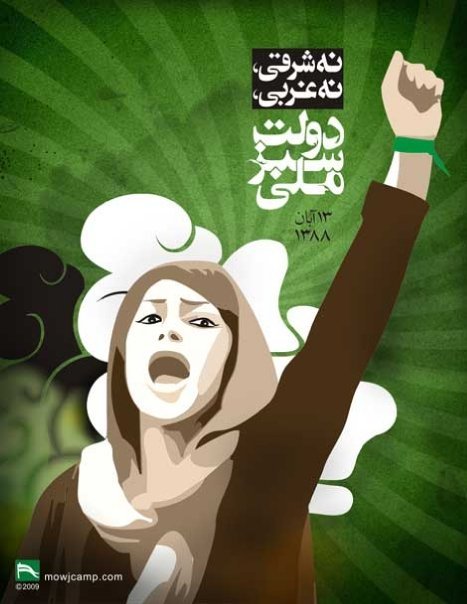
Iranian opposition forces flooded the web with calls for election protesters to join massive demonstration on the anniversary of Iran's 1979 Revolution on February 11.

Despite repeated warnings by the government that they will confront any more disruptions with no leniency, the messages defiantly suggest that the planned February 11 demonstrations could become the climactic point of all the protests and street confrontations that have marked every significant date on the Islamic Republic calendar in the past several months.

The wave of web postings also reveals that the opposition can circumvent the government's tight control on web activity and still harness the capabilities of the internet to get organized as they have done in the past several months.

In the past seven months, according to the government, over 40 people were killed in the protests, but the opposition puts the number at about 80. Thousands of people have been arrested in an attempt to quell the unrest and prominent reformists have been sentenced to long prison terms ranging from 2 to 15 years.

Five people arrested in connection with Ashura Day protests on December 27 were put on trial today facing the death penalty.

The government has made every effort to portray the protests as a foreign-backed conspiracy to topple the establishment but since the opposition leaders are prominent figures of the establishment, the authorities have refrained from arresting and prosecuting them.

While one, Mir Hossein Mousavi, was fired from his government post at the Academy of Arts and the other, Mehdi Karroubi, has been the repeated target of physical and even armed attacks, they have defiantly refused to accept the legitimacy of Mahmoud Ahmadinejad's government which they claim was fraudulently re-elected in the June presidential elections.

The Islamic Republic establishment has been dealing with deep divisions over its current crisis and even a significant section of the clergy have come out in favour of protesters and their demands.


... Payvand News - 01/19/10 ... --

SOURCE: http://www.payvand.com/news/10/jan/1170.html

Thursday, January 7, 2010

Think Again: Iran's Green Movement It's a civil rights movement, not a revolution.


Think Again: Iran's Green Movement
It's a civil rights movement, not a revolution.
BY HOOMAN MAJD | JANUARY 6, 2010


"The Green Movement Is Winning."
Yes, but over time. The answer depends on what "winning" means. One thing Western observers should have learned from 30 years of second-guessing Iran and Iranians is that second-guessing Iran and Iranians is often a mistake, and predicting the imminent demise of the Islamic theocracy is unrealistic.

What is evident is that if we consider Iran's pro-democracy "green movement" not as a revolution but as a civil rights movement -- as the leaders of the movement do -- then a "win" must be measured over time. The movement's aim is not for a sudden and complete overthrow of Iran's political system. That may disappoint both extremes of the American and Iranian political spectrums, left and right, and especially U.S. neoconservatives hoping for regime change.

Seen in this light, it's evident that the green movement has already "won" in many respects, if a win means that many Iranians are no longer resigned to the undemocratic aspects of a political system that has in the last three decades regressed, rather than progressed, in affording its citizens the rights promised to them under Iran's own Constitution.

The Islamic Republic's fractured leadership recognizes this, as is evident in its schizophrenic reaction to events since the disputed June election. Although the hard-liners in power may be able to suppress general unrest by sheer force, the leadership is also aware that elections in the Islamic state can never be held as they were in 2009 (even conservatives have called for a more transparent electoral system), nor can the authorities completely silence opposition politicians and their supporters or ignore their demands over the long term.

It augurs well for eventual democratic reform in Iran that the green movement continues to exist at all. Despite all efforts by the authorities to portray it as a dangerous counterrevolution, the green movement continues to attract supporters and sympathizers from even the clergy and conservative Iranians.

"The Green Movement Is Radicalizing."

Only in part. It's important to remember that Iran's green movement began well before protests broke out in June 2009. The origins were in the mowj-e-sabz, also known as the "green wave," a campaign to support the presidential bid of reformist candidate Mir Hossein Mousavi, who ran against conservative incumbent Mahmoud Ahmadinejad.

The green wave's goals were to wrest the presidency and executive power away from radical hard-liners whose term in office had been marked by economic incompetence, foreign-policy adventurism, and an ideological doctrine that included new limits on civil rights and that Mousavi's supporters believed was unsuited to Iranian interests in the 21st century.

After the disputed election results, the green movement morphed from a political campaign into a campaign to annul the presidential election -- and then, more broadly, into a movement to restore the civil liberties promised by the 1979 Islamic Revolution. With every instance of recent government tyranny, from show trials of opposition politicians and journalists to the beatings and murders of some demonstrators on Iran's streets, the movement has grown more steadfast in its demands for the rights of the people.

Over time, and particularly with the government's continued use of brutal force against its citizens, some Iranians are no longer satisfied with the stated goals of the green movement, but are looking to topple the Islamic regime altogether. For instance, we hear in the Western media many instances of Iranians clamoring for an "Iranian," rather than Islamic, republic (a call that Mousavi has disavowed) or for "death to the supreme leader." Meanwhile we see on YouTube and our TVs footage of Iranians violently confronting security forces.

However, the radical elements claiming to be a part of the green movement only speak for a small minority of Iranians. The majority still want peaceful reform of the system and not necessarily a wholesale revolution, bloody or otherwise. That's why, in the most recent Ashura demonstrations, for example, large groups of peaceful marchers actually prevented some of the movement's radicalized elements from beating or attacking security forces. Although accurate polling information is not available, based on what we hear and see of the leaders of the green movement and many of its supporters, radicalization is still limited to a minority of protesters.

The green movement's leaders recognize that any radicalization on their part will only bring down the state's iron fist. They are also cautious because they know that if movement leaders call for regime change rather than reform and adherence to the Constitution, they will only have proven the government's assertion that the movement's goal all along has been to topple the system.

"The Revolutionary Guards Will Do Anything to Keep Khamenei in Power."

Don't bet on it. The Revolutionary Guards are tasked with protecting the legacy of the 1979 Islamic Revolution and its embodiment in the vali-e-faqih, the supreme leader, currently Ayatollah Ali Khamenei.

The Guard's top leaders are military men who have served many years in the ranks and as such are unlikely to disobey the orders of their commander in chief. Their view, as they have expressed repeatedly in public fora, is that the green movement and its leaders are a threat to the revolution and to the supreme leader. But they are probably more concerned with protecting the position of the leader (and their own power and pervasive influence in Iranian business and politics) than they are in protecting a particular individual.

There are many former top commanders of the Guards, such as Mohsen Rezai (a defeated candidate in the presidential election), Mohammad Qalibaf (Tehran's popular mayor), and Ali Larijani (speaker of the parliament), who oppose Ahmadinejad (and have influence with the Guards), but have not so far challenged the supreme leader. That doesn't mean, though, that they would not look to replace Khamenei should it become apparent that he is an obstacle to the regime's stability. Although any moves against the supreme leader are highly unlikely at this point (and he still has the support of the majority of the members of the Assembly of Experts, the body that elects, monitors, and can even impeach him), that doesn't mean that such a challenge could never happen.

"The Time for Compromise Is Over."

Not in Iran, it ain't. The supreme leader, the Revolutionary Guards, and almost all of the hard-liners in government have said that they will tolerate no more dissent; they have said that there will be no compromise and that the green movement's demands will not be met. But that doesn't actually mean that some form of compromise isn't possible.

For starters, the green movement's leaders may recognize that they could become irrelevant if they are unwilling to either become more revolutionary (as some of their supporters already have), or compromise to protect the longevity of their movement as a civil rights campaign.

On Jan. 1, Mousavi listed the green movement's demands on civil rights and other reforms, but significantly he was no longer calling for an annulment of the 2009 election. Meanwhile, at the most recent meeting of the Expediency Council, the body that arbitrates disputes between Iran's executive and legislative branches, Mohsen Rezai, the conservative challenger to Ahmadinejad in the 2009 election, suggested that the government should listen to Mousavi's demands, describing them as "constructive." (Some Iran observers say the green movement is leaderless and argue that a headless movement will ultimately fail. And yet we're still hearing chants of "Ya Hossein, Mir Hossein!" at every protest. That's Mousavi.)

Both sides realize that the continuing unrest threatens the country's stability and that neither side is looking to reform the regime into oblivion. The current standoff makes no one happy. The odds aren't horrible that some form of compromise might occur in 2010, a compromise that would allow both sides to claim advances if not outright victory.

"The Green Movement Wants or Needs Foreign Support."

Dead wrong. Nothing could be further from the truth. It is insulting and patronizing to suggest, as many commentators do, that without foreign help or support the green movement cannot be successful, that Iranians on their own are incapable of commanding their own destiny.

U.S. President Barack Obama has so far expressed only moral support for Iranians fighting for their civil rights and has rightly articulated the unrest in Iran as a purely Iranian affair. Lacking relations with Iran, Obama can do little to help the green movement, but plenty to hurt it. Coming out squarely on the side of the opposition in Iran is likely to undermine its credibility, and perhaps even lend credence to the government's assertion that the movement is a foreign-inspired plot that will rob Iran of its independence.

That the green movement has survived, and even grown, in the absence of foreign support (even moral support in its inception) is evidence that Iranians are perfectly capable of maintaining a civil rights movement and agitating for democratic change without the prodding, influence, or support of foreigners. Furthermore, if there is only one aspect of the Islamic Revolution that almost all Iranians can agree on as positive, it's that key events, such as the spontaneous unrest after the election and all the way back to the revolution itself, have happened independent of foreign influence.

The most potentially damaging accusation the government has made against the green movement is that it is a foreign plot to foment a "velvet" or "color" revolution that will once again render Iran subservient to a greater power. But this accusation has not stuck because the movement's leaders have always eschewed any foreign support and framed their fight as a purely Iranian one.

The idea that foreign support is either necessary or important to the green movement's ability to achieve its goals is as preposterous as imagining, say in 1965, that overt Soviet support of the civil rights movement in the United States was necessary for that movement to be successful.

For observers sitting in the United States or anywhere outside Iran, it is tempting to draw conclusions about the green movement or even the health of the Islamic regime based on what little information we are able to gather and what various analysts believe, given the extreme restrictions Iran has placed on journalists and reporting from Iran. However, Iran often defies expectations and has proven maddeningly immune from adhering to conventional wisdom. Listen to an Iranian exile opposed to the Islamic regime for five minutes and you'll be convinced that the regime's days are numbered not in years, but in months. Listen to a regime apologist for five minutes and you might be persuaded that Western powers are indeed fomenting the revolt and that the government will weather the storm and emerge as powerful as ever.

The truth, of course, always lies somewhere in between. The green movement is most definitely real, cannot be completely suppressed, and will undoubtedly have a long-term effect on the politics of the Islamic Republic. What began with the election of reformist President Mohammad Khatami in 1997 has finally culminated in a civil rights movement that by any name will continue to put pressure on the regime to reform, pressure that it can only ignore at the peril of its own demise.

http://www.foreignpolicy.com/articles/2010/01/06/think_again_irans_green_movement?page=0,0

Thursday, December 31, 2009

Iran's mullahs could fold under new demands for justice


By ROUZBEH PARSI and TRITA PARSI
The Daily Beast

With the government growing increasingly desperate — and violent — the new clashes on the streets in Iran may very well prove to be the breaking point of the regime. If so, it shows that the Iranian theocracy ultimately fell on its own sword. It didn't come to an end due to the efforts of exiled opposition groups or the regime change schemes of Washington's neo-conservatives. Rather, the Iranian people are the main characters in this drama, using the very same symbols that brought the Islamic Republic into being to close this chapter in a century-old struggle for democracy.

Protests flared up again because of Ashura, the climax of a month of mourning in the Shiite religious calendar. It is a day of sadness for the death of the Prophet Muhammad's grandson, Imam Hussain, who was martyred in 680. And this year the commemoration coincided with the seventh day after the death of dissident Grand Ayatollah Ali Montazeri, adding to the significance of the day. Ashura is also a reminder that the eternal value of justice must be defended regardless of the odds of success. This has provided the relentless Green movement with yet another opportunity to outmaneuver the Iranian government by co-opting its symbols and challenge its legitimacy through the language of religion.

This battle cry for justice in all its simplicity is where most political conflagrations start. It is the deafness of the powers that be that often make them the kernel of something larger and more earth shattering. It is testimony to the arrogance of power that a simple and rather modest call for accountability and justice is beaten down only to return, demanding more, and less willing to compromise and accommodate.

And it wouldn't be the first time. In 1906, the call for a house of justice went unheeded and was followed by demonstrations, and eventually transformed into a demand for a written constitution. Similarly Mohammad Reza Shah Pahlavi, in his imperial ineptitude, brought on himself an increasingly anti-monarchical coalition, ranging from liberals and communists, to the victorious Islamists who forged the Islamic Republic in 1979.

Ashura, with its story of perseverance and martyrdom in the face of overwhelming force of oppression, was a perfectly stylized allegory for the struggle between the mighty state of the Shah and the revolutionaries at the end of the 1970s. The Shiite mourning rituals with their revisiting of the dead on the 3rd, 7th and 40th day of death provided the demonstrators then, as well as now, with the opportunity to both remember those who died for the cause as well as re-iterating their opposition and condemnation of that state repression. This played an important role in bringing the simmering political discontent to a boiling point and wearing down what was perceived as the all-powerful Pahlavi state in 1977-78.

It is even more important this time around since there is no extensive leadership structure that steers the opposition. The ability to bring out crowds for important days of the calendar, religious and revolutionary ones, reminds everyone that they are not alone in their opposition to the current government.

No one can predict a revolution nor say with certainty when an authoritarian state loses its footing if not its grip. For it is not necessarily its ability or will to repress that will falter as much as ordinary people's unwillingness to allow themselves to be cowed and intimidated. It is a battle of wills where, on the one hand, the constant mobilization and tension pervading a discontented and rebellious society tests the state machinery's ability to endure as they try to perform their functions (including repression). Weighing in on the other side of the balance is the patience and capacity to stomach pain and suffering of the protesters and their sympathizers in all quarters of society.

Today a significant number of the original revolutionaries of 1979 are imprisoned or being harassed by shadowy groups from the borderlands of state authority. The constituency of the Islamic Republic is becoming increasingly alienated as the hard line faction ruling Tehran demands loyalty to an increasingly surreal understanding of, and vision for, Iranian society. Not much is left of the dynamism and visions that fuelled the revolution of 1979 — but having learned from that experience the demands of the reformist movement today are much more sophisticated and their abstention from violence so much more promising for the future.

The state's ability to use the language of religion to repress these developments is failing. Again and again religion has proven itself to be much better suited as a language of resistance than governance. This became increasingly clear to Khomeini himself after the success of the revolution. In the constant bickering within the revolutionary elite, Khomeini increasingly invoked reasons of state for justifying actions, demoting religion to the role of ideological veneer. By the end of his life he stated that the state could abrogate the basic principles of Islam if it deemed necessary for the survival of the Islamic Republic.

Instead of a system where religious thinking controlled and wielded state power he ended up with an arrangement where the state utilized religion for its own purposes, emptying religion and its language of substance, discarding it on the growing heap of unfulfilled promises of the revolution.

Ashura, the commemoration and the principle it invokes, proves to be relevant yet again, as those who hold the reins of power in Tehran unleash violence against their own people. Undoubtedly the people of Iran will persevere in their quest for greater freedom and justice through their non-violent transformation of the system from within. It will indeed be ironic if the Iranian theocracy begins to crumble on the most important religious day of the Shiite calendar.

Rouzbeh Parsi is a research fellow at the European Institute for Security Studies. Trita Parsi is the president of the National Iranian American Council and the 2010 Recipient of the Grawemeyer Award for Ideas Improving World Order.

Wednesday, December 30, 2009

Obama 'bearing witness' is crucial to Iran

Source: http://www.cnn.com/2009/OPINION/12/29/dabashi.iran.bearing.witness/

By Hamid Dabashi, Special to CNN
December 30, 2009 1:58 p.m. EST


New York (CNN) -- If someone asked me six months ago what would change on the national, regional or global front after Iran's presidential election in June, I would have said that nothing would. And I'm supposed to know better.

Before events in Iran unfolded over the second half of 2009, national politics had become all but irrelevant in that troubled region.

From Pakistan and Afghanistan to Israel-Palestine, from Central Asia to Yemen, geopolitics was locked in a terrorizing balance of power, a stifling politics of despair.
More presidential, parliamentary and city council elections have been held in Iran over the past 30 years than probably the entire Arab and Muslim world put together. But these elections were not the signs of a healthy democracy. They were the attempts of the Islamic Republic to legitimize its deeply troubled theocracy using the simulacrum of democratic institutions.

All that was exposed to the light by one simple edict this past fall. Grand Ayatollah Montazeri, the revered jurist who died in 2009 and was posthumously dubbed the moral voice of the anti-government Green Movement, said the Islamic Republic was neither Islamic nor a republic.

Outside Iran, national elections are either a ceremonial joke (from Morocco and Tunisia, through Libya and Algeria to Egypt and Sudan, to Jordan and Syria) or else barely consequential or positively damaging regionally (from Turkey to Israel).

But not in Iran this year. Not since June, when the Islamic Republic emerged as the ground zero of a civil rights movement that will leave no stone unturned in the moral earth of the modern Middle East.
The Green Movement, helped by Twitter and Facebook, has taken the show onto a big stage, and Iranian leader Mahmoud Ahmadinejad would like nothing better than to distract this global attention away from his domestic troubles.

Paradoxically, the man who could help Ahmadinejad in his determination to turn everyone's attention away is President Obama.

One photograph of Obama with Ahmadinejad would be a dagger to the heart of the Green Movement that would be remembered longer than the CIA-engineered coup of 1953. It would traumatize U.S.-Iran relations for another half century.

The creative civil rights movement the June presidential election in Iran unleashed is writing a new page in modern history of the country and its troubled environs.

The children of the Islamic revolution, those who one cultural revolution after another has sought to brainwash, are turning the rhetoric of the Islamic Republic on its own head. These Iranians are using every occasion since the last June election to challenge each mendacity they have been taught.

This is a cosmopolitan uprising, forming in major Iranian cities. It is a gathering storm in the capital of Tehran, and spilling into a cyberspace rebellion.

In a New York cab on my way to CNN for an interview, I received an e-mail from the streets of Tehran and read it on my iPhone. I used the message in the analysis I offered 10 minutes later to a global audience. Then my former student in Tehran wrote back to say he liked my analysis -- "and the cool color of my tie."

As the Green Movement gains ground, the regime is fighting back with all it has -- kidnapping people off the street, murder, torture, rape, kangaroo courts. Official Web sites and news agencies are failing to report the truth, distorting it, ridiculing or else attributing it to phantom foreigners. They have all failed.

The Islamic Republic is cornered; the public space is appropriated. Iranians in and out of their country, young and old, men and women, rich and poor, pious or otherwise, are all coming together.

Obama's reaction to the violent crackdown on protesters during the holy days of Tasu'a and Ashura has been measured. He has condemned "the iron fist of brutality," but continues to insist, and rightly so, that "what's taking place in Iran is not about the United States or any other country. It's about the Iranian people."

At the same time, he vows, "We will continue to bear witness to the extraordinary events that are taking place" in Iran.

That "bearing witness" means and matters more than the president's critics can dream.
The pressure on Obama "to do more about Iran," especially when it comes from a "Bomb, Bomb Iran" mentality, is hypocritical.

Iranian people have every right to peaceful nuclear technology within Nuclear Non-Proliferation Treaty regulations. And the international community has every right to doubt the trustworthiness of Ahmadinejad's government.

The worst thing that Obama can do now, not just to the best interests of Iranians but also to his own stated ideal of a regional and global nuclear disarmament, is to sit down and negotiate with Ahmadinejad.

It will legitimize an illegitimate government and will never produce a binding or trustworthy agreement. The alternative to suspending direct diplomacy with Ahmadinejad is neither more severe economic sanctions nor a military strike, which will backfire and hurt the wrong people.

The only alternative for the American president is to believe in what he has said -- bearing witness.
But carry that rhetoric further: Americans should send delegations of civil rights icons, film and sports personalities, Muslim leaders, human rights organizations, women's rights activists, labor union representatives and student assemblies to Iran. Let them connect with their counterparts in Iran and expose the illegitimate government that has suffocated the democratic aspirations of a nation for too long.

"Bearing witness" is an investment in the future of democracy in a country that is destined to change the moral map of a troubled but vital part of a very fragile planet.

The opinions expressed in the commentary are solely those of Hamid Dabashi.

Editor's note: Hamid Dabashi, a professor of Iranian studies and comparative literature at Columbia University, writes frequently on politics and world affairs.  
 

Change Iran at the Top


Source: http://www.nytimes.com/2009/12/31/opinion/31iht-edcohen.html

Change Iran at the Top


By ROGER COHEN
Published: December 30, 2009

It has come to this: The Islamic Republic of Iran killing the sons and daughters of the revolution during Ashura, adding martyrdom to martyrdom at one of the holiest moments in the Shiite calendar.

Nothing could better symbolize Iran’s 30-year-old regime at the limit of its contradictions. A supreme leader imagined as the Prophet’s representative on earth — Ayatollah Ruhollah Khomeini’s central revolutionary idea — now heads a militarized coterie bent, in the name of money and power, on the bludgeoning of the Iranian people. A false theocracy confronts a society that has seen through it.

The emperor has no clothes.

Still, let us give this theocracy credit. It has brought high levels of education to a broad swathe of Iranians, including the women it has repressed. In a Middle East of static authoritarianism, it has dabbled at times in liberalization and representative governance. It has never quite been able to extinguish from its conscience Khomeini’s rallying of the masses against the shah with calls for freedom.

The result, three decades on from the revolution, is precisely this untenable mix of a leadership invoking transplantation from heaven as it faces, with force of arms and the fanaticism of militias, a youthful society far more sophisticated than the death-to-the-West slogans still unfurled.

Nowhere else today in the Middle East does anything resembling the people power of Iran’s Green movement exist. This is at once a tribute to the revolution and the death knell of an ossified post-revolutionary order.

Something has to give, someone has to yield. If the Islamic Republic is incapable of honoring both words in its self-description — that of a religious and representative society — it must give way to an Iranian Republic.

The former course, of reform rather than overthrow, would be less tumultuous and so, I suspect, more attractive to a people weary of tumult and flanked by mayhem in Iraq and Afghanistan.

Yes, something has to give. Grand Ayatollah Hossein Ali Montazeri, whose death this month carried heavy symbolism in a land where symbols are potent, intuited the revolution’s unsustainable tensions two decades ago. It was then that the cleric once designated as Khomeini’s successor lambasted an earlier round of bloody repression and then that he began to criticize the office of the supreme leader.

Montazeri had been instrumental in 1979 in the creation of the system of Guardianship of the Jurist, or velayat-e-faqih, placing a leader interpreting God’s word atop circumscribed republican institutions. But he later apologized for his role in the establishment of the position and argued that he had conceived of it as exercising moral rather than executive authority.

His anger came to a head after the June 12 election, hijacked by the supreme leader, Ali Khamenei. Montazeri then declared: “Such elections results were declared that no wise person in their right mind could believe, results that based on credible evidence and witnesses had been altered extensively.” He lambasted what he called “astonishing violence against defenseless men and women.”

I witnessed that violence — a putsch in the spurious name of God’s will grotesquely portrayed by Khamenei as a glorious democratic moment — and it was clear at once that Iran’s leadership had taken a fatal turn. It had shunned the pluralistic evolution of the Islamic order in favor of a lockdown by the moneyed cadres of the New Right, personified by the Revolutionary Guards with their cozy contracts and pathological fears of looming counter-revolutions of the velvet variety.

You can do many things to the Iranian people but you insult their intelligence at your peril. The astonishing, taboo-breaking cry of “Death to Khamenei” echoing from the rooftops of Tehran signaled a watershed.

It is time to rethink the supreme leader’s office in the name of the compromise between religious faith and representative governance that the Iranian people have sought for more than a century. It is time for Iran to look West to the holy Shiite cities in Iraq, Najaf and Karbala, places from which Grand Ayatollah Ali al-Sistani exercises precisely the kind of moral authority and suasion — without direct executive authority — that Montazeri favored for Iran.

If the Guardianship of the Jurist can be rethought through compromise the Islamic Republic can move forward. If not, I cannot see the current unrest abating.

The Green movement is a loose coalition of divergent aims — much like the revolutionary alliance of 1979 — but is united in its demand for an end to the status quo.

A commander-in-chief transplanted from heaven is not what the Iranian people want, not after June 12; a moral guide, rooted in the ethics and religion of Persia, a guarantor of the country’s independence, may well be. It is time for a Persian Sistani.

The sons and daughters of disappointed revolutionaries do not seek renewed bloodshed. They seek peaceful change that will give meaning to the word “republic.” Khamenei, bowing to superior learning, in the best tradition of Shiism, should listen to the wisdom of Iran’s late turbulent priest.

Iran would thereby preserve its independence, the proudest achievement of the revolution, while better reflecting the will of its people, who overwhelmingly favor normalized relations with the United States.

It is time to retire the stale slogans of a bygone era. It is time for Iran to follow China’s example of 1972 in adapting to survive. Perhaps Khomeini, like Mao in Deng Xiaoping’s famous formula, was 70 percent right — and some brave Iranian leader could say that. He would thereby open the way for one of the Middle East’s most hopeful societies to move forward.

Speaking of tired slogans, it is also time for the United States — and especially Congress — to set aside formulaic thinking on Iran. Shiite Iran is not America’s enemy; Sunni Al Qaeda is, whether in Yemen, Nigeria or Pakistan. New sanctions against Tehran would only throw a lifeline to Khamenei and further enrich the Revolutionary Guards. President Obama’s outreach is still the smartest approach to Iran, a nation whose political clock has now trumped its erratic, wavering nuclear clock.

Back in February, I wrote: “The Islamic Republic has not birthed a totalitarian state; all sorts of opinions are heard. But it has created a society whose ultimate bond is fear. Disappearance into some unmarked room is always possible.” That was too much for the Iran-as-Nazi-incarnation-of-evil school, who cast me as an appeaser.

I also wrote that, “The irony of the Islamic Revolution is that it has created a very secular society within the framework of clerical rule. The shah enacted progressive laws for women unready for them. Now the opposite is true: Progressive women face confining jurisprudence. At some point something must give.”

With the birth of the Green movement, and in the spirit of Montazeri, something has given. The further, critical “giving” has to come in the supreme leader’s office, where the 30 percent error of 1979 has entrenched itself and so denied Iran the governance and society its vibrant population deserves.

Tuesday, December 15, 2009

Iran Students Hold Rival Rallies, Bazaar Closes

Reuters

TEHRAN (Reuters) - Hundreds of pro-government and pro-opposition students staged rival rallies in Tehran on Tuesday, and the capital's bazaar briefly closed down in protest at an "insult" to the Islamic Republic's founder.

The incidents, reported by official media and a reformist Web site, were another sign of tension rising in Iran once again six months after a disputed election that plunged it into its worst internal crisis since the 1979 Islamic revolution.

The authorities called for a nationwide rally on Friday to condemn the tearing up of a picture of late revolutionary leader Ayatollah Ruhollah Khomeini during opposition protests last week, a government body said in a statement.

Such an event could turn violent as the opposition has used state-sponsored demonstrations before to take to the streets.

"Death to America" and "Death to hypocrites," chanted government supporters who gathered at a branch of Azad University, the official IRNA news agency reported. "Hypocrites" referred to senior opposition figures.

"Death to the dictator," shouted pro-reform students at the women-only al-Zahra University, according to the Kaleme website of opposition leader Mirhossein Mousavi, who says the June election was rigged in President Mahmoud Ahmadinejad's favour.

Government officials have accused Mousavi's backers of desecrating Khomeini's memory during December 7 demonstrations, when police armed with batons and tear gas clashed with students.

The opposition has denied involvement in the reported incident, suggesting the authorities were planning to use it as a pretext for a renewed post-election crackdown on dissent.

Hardline clerics and other leadership loyalists have held many rallies over the last few days to vent their anger at the "insult" to Khomeini, who led the overthrow of the U.S.-backed shah and remains revered 20 years after he died.

The bazaars of Tehran and the northwestern city of Tabriz shut down for a few hours on Tuesday over the picture incident, state television reported.

DEEPENING DIVISIONS

Rejecting accusations that they had desecrated Khomeini's memory, reformist students have responded with their own gatherings this week, reformist websites said. Students form the backbone of the reform movement in Iran.

At al-Zahra University, pro-opposition students asked, according to Kaleme: "Where are you Khomeini? Mousavi is alone."

Mousavi was prime minister during the 1980s and has called for a return to the "fundamental values" of the Khomeini era.

Referring to fellow students detained in Tehran's main jail after the June election, the students chanted: "Iran has turned into a detention centre. Evin prison has become a university."

Hardline students at the university ended their rally when they encountered "the angry" opposition supporters, Kaleme said.

The official IRNA news agency gave a different picture of events at Azad University, saying pro-government students there outnumbered Mousavi supporters by a wide margin.

It said 700 students protested against the insult to Khomeini. About 100 pro-reform students gathered nearby but their rally lasted only for a short time, IRNA said.

It was impossible to independently verify the conflicting claims as Iranian authorities have banned reporters working for foreign media organisations from leaving their offices to cover protests.

Security forces have repeatedly warned that any "illegal" opposition gathering would be firmly confronted.

The June vote exposed deepening establishment divisions in the major oil producer, which are showing no signs of narrowing.

The authorities have rejected opposition charges of vote fraud and portrayed huge pro-Mousavi protests that erupted after the poll as a foreign-backed bid to undermine the Islamic state.

Last week's student protests were much smaller than those in the days after the election. But the mood seemed more radical with demonstrators chanting slogans against the clerical leadership and not just criticising Ahmadinejad's victory.

Thousands of Mousavi supporters were detained after the vote, including senior reformers. Most have been freed but over 80 people have received jail terms of up to 15 years and five have been sentenced to death over the post-vote unrest.

(Editing by Jon Hemming)

Thursday, September 24, 2009